

How to Calculate Ductile Iron Pipe Weight for Container Shipping
Summary
Accurate container weight calculation is a critical engineering and logistics task for ensuring regulatory compliance, operational safety, and cost control in the international sea freight of ductile iron pipes.
This article, grounded in engineering practice and real export scenarios, explains why shipping weight calculations differ fundamentally from theoretical design calculations. It provides a complete, step-by-step methodology—from determining the true shipping weight of a single pipe to establishing a safe and practical loading quantity per container. Common pitfalls and industry best practices are also highlighted to support reliable shipment planning.
Introduction
Overweight issues in container shipments of ductile iron pipes frequently arise from a common mistake: using the theoretical “weight per meter” from engineering design documents for logistics planning.
In international sea freight, weight calculation must be based on the container’s maximum allowable payload, not structural design assumptions. Crucially, the total shipping weight must accurately include:
Socket (bell) weight
Internal linings and external coatings
Packing and securing materials
Failure to account for these elements can result in port demurrage, overweight penalties, shipment rejection, or safety risks during loading and unloading.
This guide presents a rigorous, practical calculation framework widely used in professional export operations.
1. Core Concept: Shipping vs. Design Weight Calculations
Design calculations and shipping calculations serve fundamentally different objectives.
Design Calculations
Focus on pipe body geometry
Based on wall thickness, diameter, and nominal weight per meter
Used for structural strength and pressure rating analysis
Shipping Calculations
Focus on operational and legal compliance
Answer a practical question:
How many pipes can be safely loaded into one container without exceeding payload limits?
Key Differences
Primary Objective
Compliance with container payload limits (e.g. 20' GP: 28–28.5 t) and road transport regulationsCalculation Target
The total shipping weight per pipe, including pipe body, socket, linings/coatings, and manufacturing toleranceOperational Constraints
Stacking method, weight distribution, and packing material weight (dunnage, steel strapping)
2. Essential Data Preparation
2.1 Confirm Container Payload Limits
Always obtain the exact payload specification from the shipping line or container operator. Typical reference values are shown below:
Container Type | Internal Length (Approx.) | Max. Payload (Approx.) | Suitability Analysis |
20' GP | 5.9 m | 28.0 – 28.5 t | Most common for DN300+; usually weight-limited |
40' GP / HC | 12.0 m | 26.0 – 27.0 t | Often reaches weight limit before volume for heavy pipes |
Important: Do not confuse tare weight with maximum payload.
2.2 Determine Total Shipping Weight per Pipe
This is the cornerstone of the entire calculation.
Whenever possible, use the manufacturer’s official weight tables, which already include socket weight.
If such data is unavailable, apply the following estimation model:
Total Pipe Shipping Weight (kg)
= (Nominal weight per meter × Pipe length) + Estimated socket weight
Key Notes
For DN600 and above, socket weight may represent 10–15% of total pipe weight
Cement mortar lining and external coatings must be included
Manufacturing tolerances should always be considered
3. Step-by-Step Container Weight Calculation
Step 1: Calculate the Theoretical Maximum Quantity
Formula
N_theoretical = INT(Container Max Payload ÷ Total Pipe Shipping Weight)
Example
DN300, K9, 6 m pipe
Single pipe shipping weight ≈ 330 kg
20' GP payload limit = 28,000 kg
N_theoretical = INT(28,000 ÷ 330) ≈ 84 pipes
Step 2: Apply Practical Reduction Factors
Theoretical quantities must be reduced to reflect real loading conditions.
A reduction of 10–15% is recommended to account for:
Packing materials (wooden dunnage, steel straps)
Stacking gaps and uneven weight distribution
Mandatory safety margin (typically 3–5%)
Practical Loading Formula
N_practical ≈ N_theoretical × (0.85 – 0.90)
Example (continued)
N_practical ≈ 84 × 0.88 ≈ 74 pipes
Step 3: Verify the Stacking Method
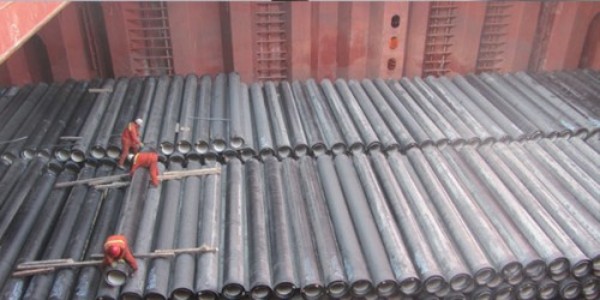
The bell-to-spigot alternating stacking method is industry standard.
Benefits:
Improved stability
Better weight distribution
Optimized space utilization
This step is especially critical for DN600 and larger pipes and should be clearly documented in the loading plan.
4. Practical Loading Reference (20' GP Container)
Nominal Diameter (DN) | Class | Export Length | Est. Single Pipe Weight (kg) | Recommended Quantity |
200 | K9 | 6 m | 150–180 | 120 – 130 |
300 | K9 | 6 m | 320–350 | 70 – 75 |
400 | K9 | 5.5 m* | 450–500 | 45 – 50 |
600 | K9 | 5.5 m | 1,100–1,300 | 18 – 22 |
800 | K9 | 5.5 m | 1,900–2,200 | 10 – 12 |
* 5.5 m length is often selected to improve space utilization in 20' containers.
5. Special Considerations & Common Errors
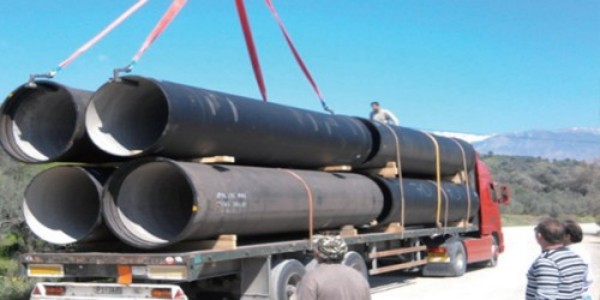
Large-Diameter Pipes (DN1000+)
Extremely high single-pipe weight
Often limited to 2–6 pipes per 20' GP
Flat rack or break-bulk shipping may be more economical
Requires project-specific assessment
Common Calculation Mistakes
❌ Using theoretical weight per meter only
❌ Ignoring socket weight
❌ Confusing tare weight with payload limit
❌ Forgetting to deduct packing material weight
❌ Mixing pipe sizes without recalculating total load
6. Best Practice Recommendations
Use verified data: Always request official manufacturer weight tables
Plan early: Confirm pipe length and packing method during inquiry stage
Maintain a safety margin: Keep at least 3–5% below payload limit
Coordinate logistics: Review loading plans with freight forwarders in advance
Conclusion
Accurate container weight calculation is a critical interface between engineering and logistics in the international supply chain of ductile iron pipes. It directly affects shipment compliance, cost control, and operational safety at ports and project sites.
As a professional ductile iron pipe supplier, we support our partners not only with precise technical data, but also with practical loading verification and optimization advice based on extensive global project experience. Ensuring that every shipment arrives safely, legally, and efficiently is a shared professional responsibility.
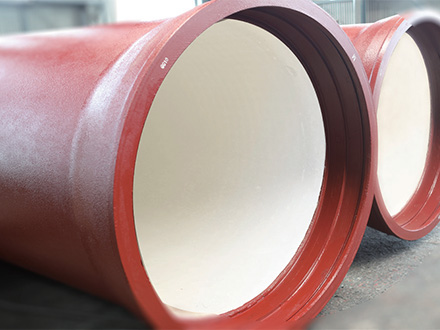 Sewage Pipe (Ductile Iron Sewage Pipe)
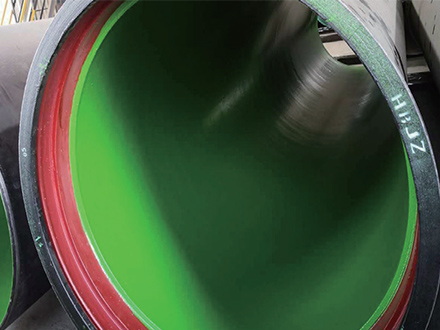 Special Coating Pipe (Ductile Iron Pipe with Special Coatings)
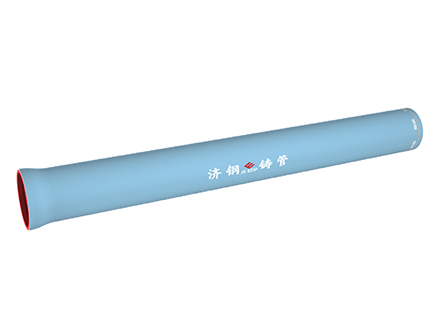 Dragging Pipe (Ductile Iron Dragging Pipe)