

Why Are Ductile Iron Pipes Cement Lined? The Corrosion Problem It Solves
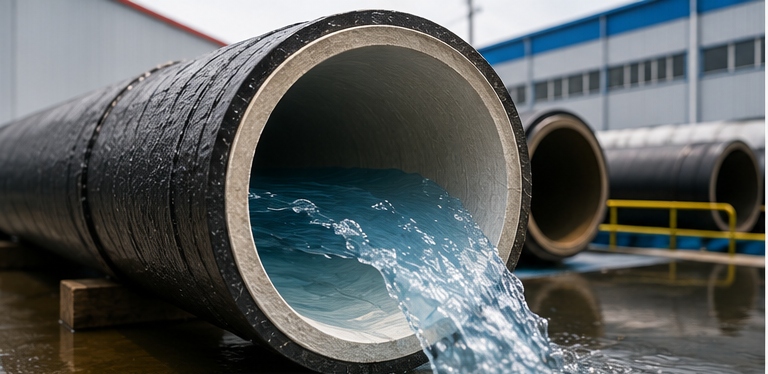
Ductile iron pipes are cement lined to stop the iron from directly contacting the water flowing through it — which prevents tuberculation, the buildup of mineral deposits on the pipe's interior wall that narrows the bore and restricts flow over time. Cement mortar lining works as both a physical barrier and a chemical one: it blocks direct contact, and it also raises the pH at the pipe wall, which further suppresses the corrosion reaction. The result is a pipe that keeps close to its original flow capacity for decades, instead of gradually losing it.
That's the short answer. The more useful question for anyone specifying or buying pipe is what this actually means in practice — how much capacity is really at stake, how well the lining holds up over the long term, and where regional practice differs. This article covers that in detail. (If you haven't read our overview of what cement lining is and how it's manufactured, start with [What Is Cement Lined Ductile Iron Pipe?] first.)
1. What Happens If Iron Pipe Isn't Lined
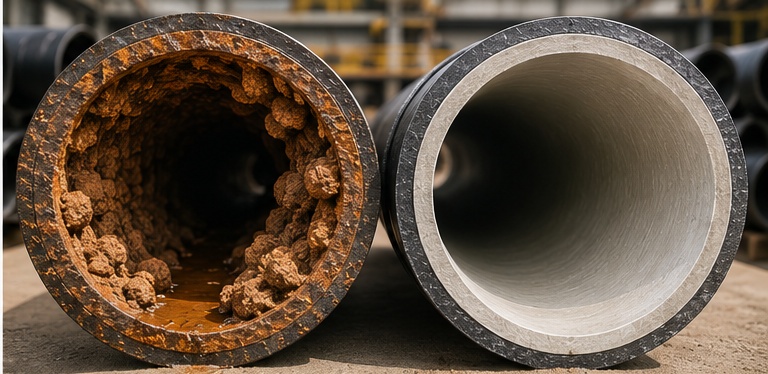
Bare ductile iron in contact with water corrodes. Iron reacts with dissolved oxygen and minerals in the water, and the corrosion products — mostly iron oxides — deposit on the interior wall as rough, uneven nodules called tubercles. This process, tuberculation, does two things simultaneously:
Shrinks the effective bore. The tubercles physically occupy space inside the pipe, reducing the cross-sectional area available for flow.
Roughens the interior surface. A rough, tuberculated surface creates far more friction than a smooth one, which further slows flow independent of the bore reduction.
Both effects compound over time. A pipe that isn't protected doesn't fail suddenly — it just quietly loses capacity year after year until flow and pressure problems show up downstream, often long after the original installation contract is a distant memory.
2. How Cement Lining Interrupts the Process
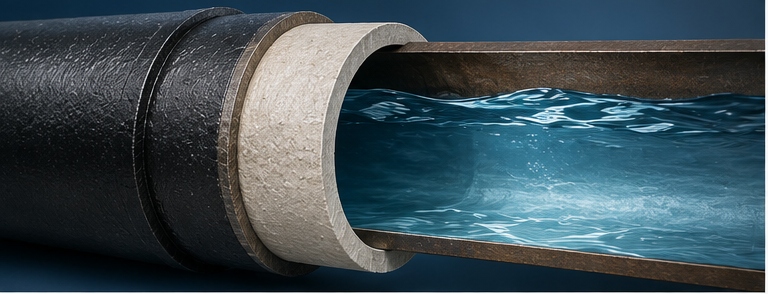
Cement mortar lining addresses tuberculation through two mechanisms working together, not just one:
Physical barrier. The mortar layer simply keeps the water from touching the iron at all, removing the direct contact that drives corrosion.
Chemical barrier. The cement raises the pH right at the pipe wall, which suppresses the corrosion reaction chemically. On top of that, as water works into the lining's surface pores, free lime in the cement reacts with dissolved minerals in the water to form calcium carbonate — which then clogs those same pores, progressively sealing the lining against further water penetration. It's a self-reinforcing protective process, not a one-time coating.
This combination is why cement lining has remained the default choice for a century, rather than being replaced by a simpler single-mechanism barrier.
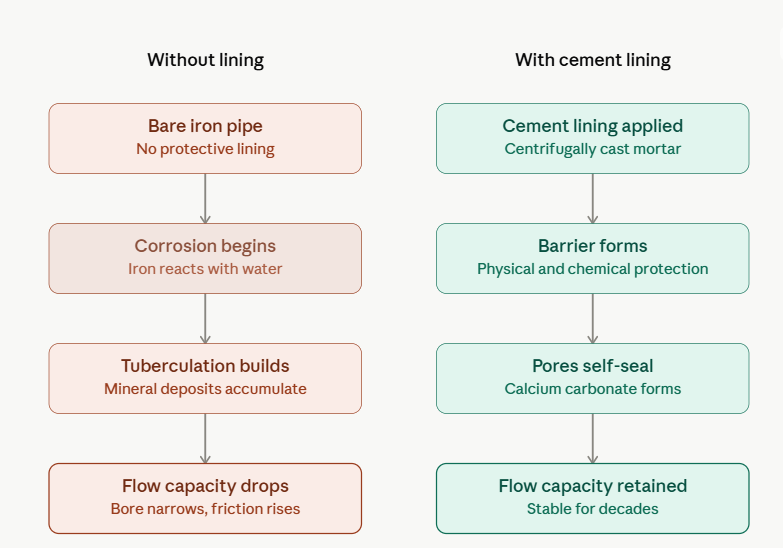
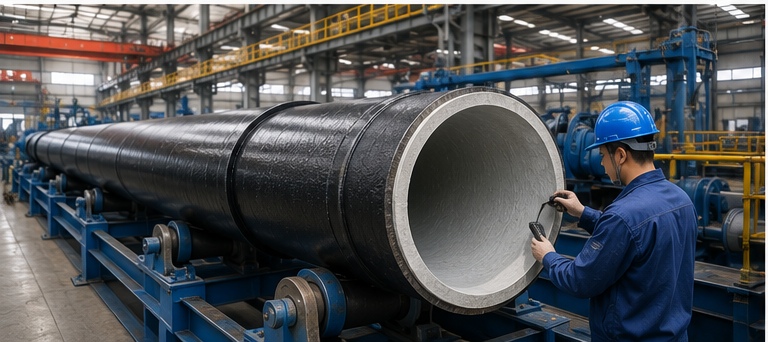
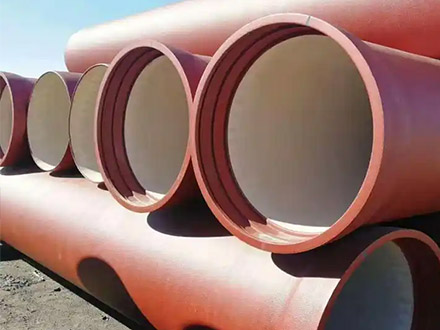
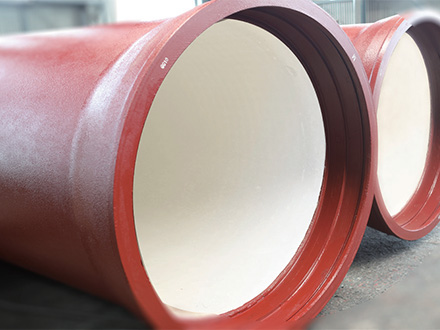
A cement lined ductile iron pipe interrupts the corrosion process at the point where bare iron would otherwise begin building up tuberculation.
3. Quantifying the Difference: What Actually Happens to Flow Capacity Over Time
This is the part most technical explanations skip — and it's the part that actually matters for anyone comparing lined and unlined pipe economically.
3.1 Flow Capacity Loss in Unlined Pipe
Unlined pipe is commonly estimated to start around a Hazen-Williams C-value of 130 when new, and can decline substantially as tuberculation builds — some field studies and engineering references cite drops to the 80 range over roughly 30 years of service, with more severe cases reported even lower depending on water chemistry and soil conditions. Since C-value directly drives friction loss in the Hazen-Williams flow equation, this isn't a minor technicality — it's a steadily shrinking safety margin on a pipeline's original hydraulic design.
3.2 How Cement Lining Improves Long-Term Hydraulic Performance
A cement lined ductile iron pipe performs very differently. The Ductile Iron Pipe Research Association (DIPRA) has long maintained that lined pipe holds a constant C-value of 140 indefinitely. It's worth noting, in the interest of giving buyers a complete picture rather than just an industry talking point: independent research — including a 2017 Virginia Tech study and utility flow-test data from multiple U.S. cities — has found that cement-lined pipe does experience some gradual C-value decline too, at documented rates in the range of roughly 0.2–0.5 per year depending on water conditions. That's a real decline, but a dramatically slower one than unlined pipe experiences.
One of the more compelling real-world data points comes from the very first installation: cement lined ductile iron pipe installed in Charleston, South Carolina in 1922 was flow-tested in 1999 — 77 years later — and still measured a C-value of 130. Few pipeline materials have a documented, near-century-long field track record to point to.
What this means practically: even accounting for the more conservative, independently-measured degradation rates, a properly specified cement lined ductile iron pipe retains dramatically more of its original flow capacity over a multi-decade service life than unlined pipe does. For a water utility or industrial operator, that translates directly into lower long-term pumping energy costs (since a narrower, rougher bore requires more pump head to move the same volume of water) and a much longer interval before capacity problems force premature pipe replacement or in-place rehabilitation.
For a full breakdown of expected service life and the factors that affect it, see [Cement Lined Ductile Iron Pipe Service Life: How Long Does It Last?]
4. Procurement Implications
Understanding why pipe is cement lined matters most when it changes what you actually check before ordering. When comparing ductile iron pipe suppliers, buyers should verify more than whether cement lining is included — that alone isn't a complete specification. It's equally important to confirm:
Applicable lining standard — ISO 2531/EN 545 or ANSI/AWWA C104, depending on your project's governing framework
Lining thickness — scales with pipe diameter and should match the standard your project specifies
Factory quality inspection procedures — how lining thickness and bond quality are verified before shipment
Water application compatibility — potable, reclaimed, or wastewater service can call for different lining considerations
Third-party inspection requirements, if your project mandates independent verification before or after shipment
Confirming these details upfront reduces long-term maintenance risk and helps ensure the pipe you receive actually matches your project's specification — rather than discovering a mismatch after installation.
5. A Regional Difference Worth Knowing About
One detail that rarely comes up outside the U.S. market: American practice sometimes adds a thin asphaltic seal-coat over the cement lining, in locations where water is aggressive enough that leachate from the bare cement could raise the water's pH or hardness noticeably. Outside the United States, cement-lined ductile iron pipe and fittings are typically supplied without a seal-coat — the cement lining alone is standard practice in most of the world.
This matters at the quotation stage: if you're comparing quotes across suppliers or regions, confirm whether a seal-coat is included or expected, since it isn't a universal default and its presence (or absence) should match your project specification rather than being assumed either way.
6. Frequently Asked Questions
Is cement lining better than epoxy lining?
Neither is universally "better" — they suit different conditions. Cement lining is the lower-cost, proven default for standard potable water service, while epoxy is typically specified when water chemistry is aggressive enough that cement lining alone isn't sufficient. See [Cement Lined vs Epoxy Lined Ductile Iron Pipe] for a full technical and cost comparison.
How long does cement lining actually protect the pipe?
There's no fixed expiration point — the lining's protective mechanism (physical barrier plus ongoing pore-sealing via calcium carbonate formation) continues working as long as the lining remains intact and bonded. Documented field cases show cement-lined pipe performing well after 70+ years of service. See our service life guide for the specific factors that influence how long a given installation will last.
Is it true that cement-lined pipe's flow coefficient never changes?
Industry sources have historically stated the C-value stays constant at 140, but independent field studies show a slower, gradual decline is more accurate — still far better than unlined pipe, just not literally zero change. It's a useful distinction to know when comparing manufacturer claims to independent engineering literature.
Does cement lining need a seal-coat to work properly?
No — a seal-coat is an additional protective layer used in the U.S. in specific cases of aggressive water chemistry, not a requirement for the cement lining itself to function. Most cement-lined pipe worldwide is supplied without one.
Can tuberculation still occur if the cement lining is damaged?
Localized damage exposes bare iron to water at that specific point, so yes, tuberculation could begin there — though cement lining's documented self-healing behavior (see our pillar article on what cement lining is) means minor cracking often reseals on its own rather than progressing.
Does the pipe's flow capacity affect what size I should specify?
Yes — if your hydraulic design assumes a constant C-value over the pipeline's design life, using a value closer to the long-term, gradually-declining figure (rather than the optimistic new-pipe number) gives a more conservative and realistic basis for sizing, especially for long design horizons.
For projects with different water conditions or regional standards, selecting the appropriate lining specification is just as important as selecting the pipe itself. Tiegu helps international buyers coordinate qualified manufacturers, verify lining specifications, and align technical requirements with project standards — helping reduce specification risk before production begins.
📐 Engineers & project buyers: Send us your design flow, pressure, and service life requirements and we'll confirm lining and coating specifications appropriate to your water conditions. Submit your project requirements →
📦 Distributors & trading companies: Sourcing cement-lined pipe across multiple projects or specifications? We coordinate across multiple qualified factories to match the right lining spec to each order. Get a quotation →
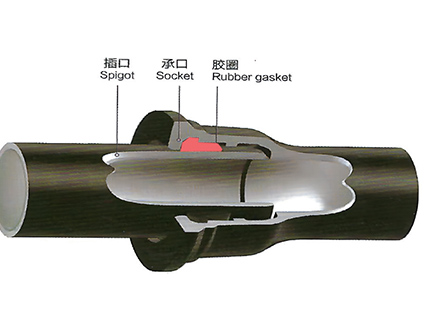 GT-type Joint Ductile Iron Pipe
 Sewage Pipe (Ductile Iron Sewage Pipe)
 Special Coating Pipe (Ductile Iron Pipe with Special Coatings)