

Ductile Iron Pipe Sizes and Dimensions: Complete DN/OD/ID Reference Guide
Quick Answer: Ductile iron pipe sizes range from DN80 (3") to DN2600 (104"), governed by three main international standards — ISO 2531/EN 545 (metric DN, most common outside North America), AWWA C151 (inch-based, used in the US), and AS/NZS 2280 (Australia/New Zealand). For a given DN, the outside diameter (OD) is fixed by standard, while wall thickness varies by pressure class (K7–K12 or C25–C40), which in turn determines the inside diameter (ID) and weight per meter. A DN300 K9 pipe, for example, has an OD of 326 mm, a wall thickness of 7.2 mm, and weighs roughly 54 kg/m.
Choosing the right ductile iron pipe size isn't just about matching a nominal diameter — it's about understanding how DN, OD, ID, and pressure class interact, and how that interaction differs depending on which standard your project follows. This guide breaks all of it down with real dimensional data, so you can specify, quote, or purchase with confidence.
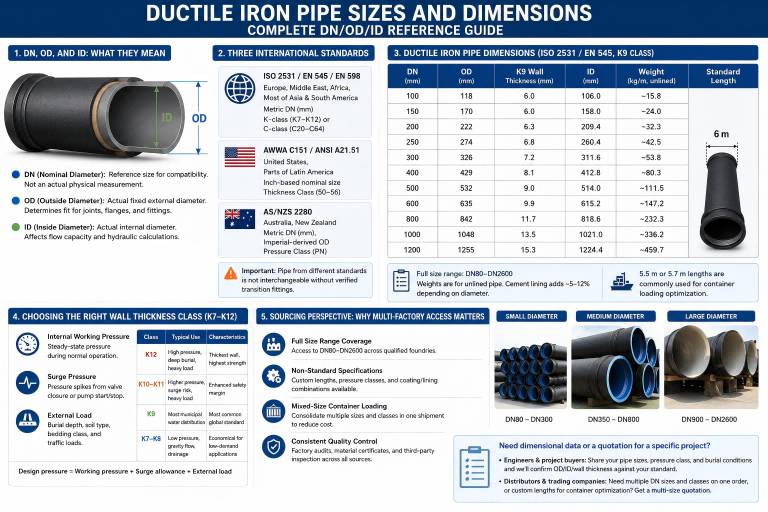
1. DN, OD, and ID: What They Actually Mean (and Why the Difference Matters)
Three measurements come up constantly in ductile iron pipe specs, and mixing them up is one of the most common (and costly) sourcing mistakes:
DN (Nominal Diameter) is a rounded reference number, not a physical measurement. DN300 doesn't mean the pipe is exactly 300 mm anywhere on it — it's a size class used for compatibility across fittings, valves, and joints.
OD (Outside Diameter) is the actual, fixed external measurement for a given DN under a given standard. This is what determines whether your flanges, couplings, and tapping sleeves will fit.
ID (Inside Diameter) is what's left after subtracting wall thickness from the OD on both sides. Since wall thickness changes with pressure class, ID is not fixed — a thicker-walled K12 pipe has a smaller ID than a K9 pipe of the same DN.
This matters practically in a few common situations:
Flow and pressure calculations depend on ID, not DN — using the nominal size instead of the actual ID in hydraulic calculations can meaningfully understate friction losses on long transmission lines.
Tapping sleeves, couplings, and pipe supports are selected based on OD, so the OD must be confirmed before ordering — especially when connecting pipe from different manufacturers or standards.
Pigging and lining work requires the ID, since the pig or lining equipment has to pass through the actual bore, not the nominal one.
Key Point: Always request OD, ID, and wall thickness by pressure class when quoting a project — "DN300" alone is not a complete specification.
2. Three International Standards, Three Different Dimension Systems
Ductile iron pipe is not dimensionally universal. A pipe manufactured to one standard will not necessarily match the OD of a pipe manufactured to another, even at the "same" nominal size. This is one of the most common — and expensive — mistakes in cross-border procurement, especially when a project mixes pipe, fittings, or valves sourced from different regions.
| Standard | Region typically specified | Sizing system | Common pressure class notation |
|---|---|---|---|
| ISO 2531 / EN 545 (water) / EN 598 (sewerage) | Europe, Middle East, Africa, most of Asia and South America | Metric DN (mm) | K-class (K7–K12) or C-class (C20–C64) |
| AWWA C151 / ANSI A21.51 | United States, parts of Latin America | Inch-based nominal size | Thickness Class (50–56) |
| AS/NZS 2280 | Australia, New Zealand | Metric DN (mm), imperial-derived OD | Pressure Class (PN) |
Why this matters for procurement: DN300 under ISO 2531/EN 545 has an OD of 326 mm. A nominally "equivalent" 12-inch AWWA C151 pipe has a different OD. They are not interchangeable, and mixing them on the same pipeline without adapters or verified transition pieces leads to joint and gasket failures. If your project specification references AWWA standards but your regional supply market defaults to ISO/EN, this should be flagged and resolved before pipe is ordered — not after it arrives at the port.
Most projects across Southeast Asia, South Asia, the Middle East, and Africa specify ISO 2531 / EN 545, so the reference tables below use that system. If your project calls for AWWA C151 or AS/NZS 2280 dimensions, let your supplier know at the inquiry stage — the OD, wall thickness, and pressure class tables are different for each standard.
3. Ductile Iron Pipe Dimensions Table (ISO 2531 / EN 545, K9 Class)
K9 is the most widely specified pressure class for municipal water distribution worldwide, so it's used as the reference class below. Wall thickness for K-class pipe follows the ISO 2531 formula e = K × (0.5 + 0.001 × DN), where K is the class number (9 for K9) and DN is the nominal diameter in mm. This is why wall thickness — and therefore ID and weight — increases steadily with pipe size, even though the pressure class stays the same.
| DN | OD (mm) | K9 Wall Thickness (mm) | ID (mm) | Weight (kg/m, unlined) | Standard Length |
|---|---|---|---|---|---|
| 100 | 118 | 6.0 | 106.0 | ~15.8 | 6 m |
| 150 | 170 | 6.0 | 158.0 | ~24.0 | 6 m |
| 200 | 222 | 6.3 | 209.4 | ~32.3 | 6 m |
| 250 | 274 | 6.8 | 260.4 | ~42.5 | 6 m |
| 300 | 326 | 7.2 | 311.6 | ~53.8 | 6 m |
| 400 | 429 | 8.1 | 412.8 | ~80.3 | 6 m |
| 500 | 532 | 9.0 | 514.0 | ~111.5 | 6 m |
| 600 | 635 | 9.9 | 615.2 | ~147.2 | 6 m |
| 800 | 842 | 11.7 | 818.6 | ~232.3 | 6 m |
| 1000 | 1048 | 13.5 | 1021.0 | ~336.2 | 6 m |
| 1200 | 1255 | 15.3 | 1224.4 | ~459.7 | 6 m |
Full size range: DN80–DN2600. Weights shown are for unlined pipe; cement-lined pipe adds roughly 5–12% depending on diameter. Standard laying length is 6 m, though 5.7 m or 5.5 m lengths are commonly used to optimize container loading — see Section 6.
⚠️ Procurement Tip: Weight per meter directly affects freight cost and lifting equipment selection. A 6 m length of DN800 K9 pipe weighs close to 1.4 tons — factor this into container load planning and confirm your destination port has adequate unloading equipment for large-diameter shipments.
4. Choosing the Right Wall Thickness Class (K7–K12)
DN determines which fittings and joints a pipe is compatible with. Wall thickness class determines whether the pipe can actually handle your project's operating conditions. The three factors that drive class selection:
Internal working pressure — the steady-state pressure the pipe carries during normal operation.
Surge pressure (water hammer) — pressure spikes from valve closure or pump start/stop, which can temporarily exceed working pressure by 50–100%. Design pressure = working pressure + surge allowance, not working pressure alone.
External load — burial depth, soil type, trench bedding class, and traffic loads all add stress independent of what's flowing through the pipe. Deep burial (>3 m) or heavy road traffic often pushes the required class up even when internal pressure is modest.
K9 covers the majority of municipal water distribution projects. K10–K12 is typically specified for deeper burial, higher surge risk, or heavier external loading; K7–K8 may be used for low-pressure gravity or drainage applications where local codes permit. The correct class should always be confirmed against your project's hydraulic design and geotechnical conditions — a size chart alone can't replace that calculation, but it tells you what's physically available to specify.
5. Sourcing Perspective: Why Multi-Factory Access Affects Size and Class Availability
Dimension standards are consistent on paper, but availability in practice is not. A single foundry typically has a fixed casting range — some are set up efficiently for DN80–DN600, others specialize in large-diameter DN800–DN2600 castings, and mold changeovers for less common combinations (e.g., K12 wall thickness above DN1000, or non-standard 5.5 m lengths for tight container loading) can mean long lead times or outright unavailability from a single source.
This is where working with a trading partner that coordinates across multiple qualified foundries makes a practical difference for buyers and distributors:
Full size range coverage — a single project bill of materials often spans small branch pipe and large trunk main sizes; sourcing across factories avoids splitting one order across multiple direct-to-manufacturer relationships.
Non-standard specifications — custom lengths (5.5 m/5.7 m for container optimization), less common pressure classes, or specific coating/lining combinations are easier to match when you're not limited to one factory's fixed production schedule.
Mixed-size container loading — export shipments rarely consist of a single DN and class. Coordinating multiple sizes into one container load, rather than running separate MOQs per factory, is a real cost and logistics advantage for distributors placing recurring orders.
Consistent QC across sources — factory audits, material certificates, and third-party inspection are standardized across the supply base rather than varying supplier by supplier.
For distributors and EPC buyers assembling multi-size orders, this sourcing flexibility often matters as much as the unit price on any single size.
6. Frequently Asked Questions
Is DN the same as the pipe's actual diameter?No. DN is a nominal reference size, not an exact measurement. The actual OD and ID depend on the standard (ISO 2531/EN 545, AWWA C151, or AS/NZS 2280) and, for ID, the pressure class.
What's the difference between K-class and C-class pipe?K-class (K7–K12) sets wall thickness as a function of nominal diameter using a fixed formula. C-class (C20–C64) instead classifies pipe by a target working pressure rating, which can result in a different wall thickness than the equivalent K-class at the same DN. Projects specify one system or the other based on the governing standard and local practice — the two are not directly interchangeable without checking the actual thickness values.
Can I mix ductile iron pipe from different manufacturers on the same project?Generally yes, if all pipe conforms to the same standard (e.g., all ISO 2531/EN 545) and pressure class, since OD and jointing dimensions are standardized. Mixing pipe across different standards (e.g., AWWA C151 with ISO 2531) is not recommended without verified transition fittings, as OD and joint dimensions differ.
What is the standard length of ductile iron pipe?6 meters is the most common standard length under ISO 2531/EN 545. For container shipping, 5.5 m or 5.7 m lengths are frequently used instead to reduce wasted container space — this is worth specifying at the quotation stage if you're optimizing for ocean freight cost.
How do I know which pressure class my project needs?Class selection depends on working pressure, surge allowance, burial depth, and soil/traffic loading — not on DN alone. K9 is standard for most municipal distribution; deeper burial or higher surge risk generally requires K10 or above. Share your pipeline profile and burial conditions with your supplier for a class recommendation appropriate to your specific conditions.
Need dimensional data or a quotation for a specific project?
📐 Engineers & project buyers: Share your pipe sizes, pressure class, and burial conditions and we'll confirm OD/ID/wall thickness against your governing standard, plus lead times across our factory network. Submit your project requirements →
📦 Distributors & trading companies: Need multiple DN sizes and classes on one order, or custom lengths for container optimization? We coordinate across multiple qualified factories to consolidate mixed-size shipments. Get a multi-size quotation →
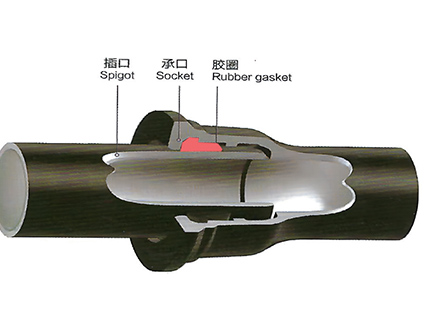 GT-type Joint Ductile Iron Pipe
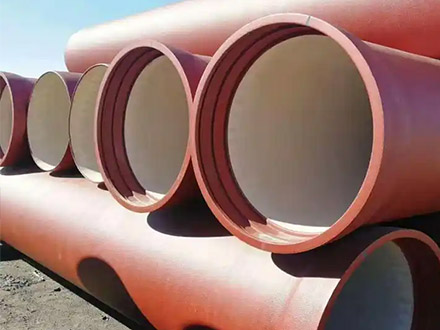
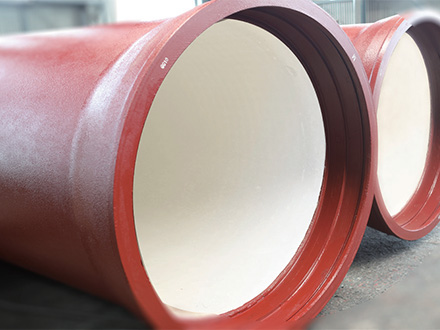 Sewage Pipe (Ductile Iron Sewage Pipe)
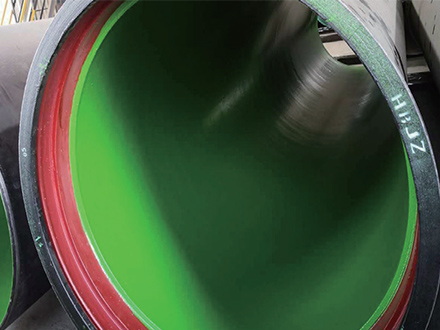 Special Coating Pipe (Ductile Iron Pipe with Special Coatings)