

Ductile Iron Pipe Lining and Coating: Cement Mortar vs Epoxy vs Polyurethane
The Decision That Determines Service Life
Most failures in ductile iron pipe networks are not caused by the iron itself. The pipe wall is strong enough to last 80–100 years under normal conditions. What fails first is almost always the protection system: the internal lining erodes, pinholes open, or the external coating loses adhesion and corrosion starts at a single holiday in the film. Once corrosion starts at a small spot, it concentrates into a pit, and the local stress riser does what steady internal pressure could not — it shortens the pipe's life.
That is why ductile iron pipe lining and coating is not a secondary procurement detail. It is the primary design decision that controls how long the asset actually lasts. The right choice depends on water chemistry, soil chemistry, operating temperature, and whether the pipe will carry potable water, raw water, sewage, or industrial fluid.
This guide compares the three most common internal linings — cement mortar, epoxy, and polyurethane — and the external coating systems normally paired with them, for projects in Southeast Asia and the Middle East where water chemistry and soil conditions vary sharply within a single pipeline corridor.
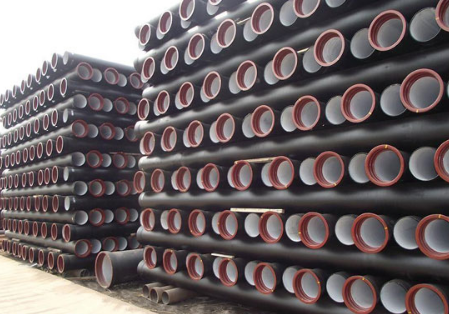
What Each Internal Lining Actually Does
Cement Mortar Lining (CML)
Cement mortar lining is the default choice for approximately 90% of water supply and sewage force main applications worldwide. It is specified in ISO 4179 and AWWA C104/A21.4. The lining is a layer of Portland cement mortar applied centrifugally to the inside of the pipe, typically 4–10 mm thick depending on diameter.
How it works: the cement mortar forms a passive, alkaline barrier on the pipe surface. Over the first few months of service, a thin calcium carbonate layer precipitates on the lining surface in contact with water, creating a self-healing film that further reduces corrosion risk. The roughness coefficient (C value) of new CML is around 130–140, and it improves with age as the surface films mature.
Best for: potable water with pH 6.5–9.5, moderate sulfate levels, and temperatures below 35°C.
Limitations: CML is vulnerable to soft or aggressive water (low alkalinity, low pH, high dissolved CO₂). In these conditions, the cement can leach calcium, causing "cement washout" and exposing the iron beneath. It is also not ideal for water with high sulfate levels (above 1,000 mg/L) or sewage with hydrogen sulfide concentrations that can attack the cement matrix.
Epoxy Lining (EP)
Epoxy linings are thermoset polymer coatings applied as a liquid and cured to form a smooth, chemically resistant film. Common types include solvent-free liquid epoxy and fusion-bonded epoxy (FBE). Typical thickness ranges from 250 μm to 800 μm depending on the product and standard.
How it works: epoxy provides a continuous, non-porous barrier between the water and the iron. It has no chemical reaction with the pipe wall; its protection is purely physical isolation. The surface is much smoother than cement mortar, with a roughness coefficient typically around 150, which reduces pumping head loss.
Best for: acidic water (pH below 6.5), high sulfate or chloride water, seawater, brackish water, and applications where low head loss matters. Frequently used in desalination plant piping, cooling water circuits, and industrial process lines.
Limitations: epoxy does not tolerate poor surface preparation. If the pipe surface is not properly cleaned and blasted, the coating can disbond in sheets. It also has a temperature ceiling — standard liquid epoxy linings are generally rated up to 60–85°C; fusion-bonded epoxy (FBE) can handle higher service temperatures but is rarely used for internal water service. Epoxy linings are more expensive than CML, typically 25–40% more per linear meter.
Polyurethane Lining (PU)
Polyurethane linings are elastomeric or rigid polymer coatings applied by spraying or centrifugal casting. They are less common than epoxy in municipal water but widely used in abrasive service such as mine slurry, tailings, and cement slurry transport.
How it works: polyurethane combines chemical resistance with high abrasion resistance. A well-applied PU lining is tough, flexible, and can handle particle impact far better than either CML or epoxy. It also has excellent adhesion when applied over properly prepared surfaces.
Best for: abrasive fluids, slurry transport, raw water with high sediment loads, and applications where mechanical wear is the dominant failure mode rather than chemical corrosion.
Limitations: polyurethane is generally not used for potable water unless it is certified to the relevant drinking water standard (NSF 61, WRAS, or local equivalent). It is also the most expensive of the three options, often 40–70% above CML pricing.
Internal Lining Selection Matrix
| Water Condition | Recommended Lining | Why |
|---|---|---|
| Potable water, pH 6.5–9.5, low sulfate | Cement mortar | Cost-effective, self-healing, widely available |
| Potable water, aggressive (low pH / high sulfate) | Epoxy | Chemical resistance, approved for potable use |
| Seawater or brackish water | Epoxy | Chloride resistance superior to CML |
| Sewage / wastewater with H₂S risk | Epoxy or PU | CML can be attacked by biogenic sulfuric acid |
| Abrasive raw water or slurry | Polyurethane | Abrasion resistance far exceeds CML and EP |
| Food-grade or pharmaceutical | Certified epoxy or PU | Regulatory approval required |
One point that is often missed: the lining decision should be based on the worst-case water chemistry the pipe will see, not the average. A transmission main may operate with clean treated water for 90% of its life, but if it is occasionally used to convey superchlorinated backwash water or raw water during emergencies, the lining must survive those events too.
External Coating — The Other Half of the Equation
Ductile iron pipe external protection typically uses a layered system rather than a single coating. The most common configuration follows EN 545: a metallic zinc or zinc-aluminum layer, covered by a bituminous or polymer finishing coat, often with a polyethylene (PE) wrapping film at the pipe ends or full PE sleeving in highly corrosive soils.
Standard Metallic Coating: Zinc or Zinc-Aluminum
The standard external protection under EN 545 is a zinc-aluminum coating (approximately 95% Zn / 5% Al by mass), applied by metal spraying to a thickness of about 200 g/m². This is then covered by a finishing layer to prevent white rust formation.
How it works: the zinc-aluminum layer acts as a sacrificial anode. If the coating is scratched down to bare iron, the surrounding zinc corrodes preferentially, protecting the exposed iron. This is why small holidays in the coating do not immediately lead to pitting — the cathodic protection effect buys time for repair.
Best for: most natural soils, including moderately corrosive clay and sandy soils, in buried applications.
Fusion-Bonded Epoxy (FBE) External Coating
FBE is a thermoset powder coating applied to a blasted pipe surface and cured at high temperature. It provides a thick, abrasion-resistant, chemically resistant barrier.
Best for: marine environments, splash zones, highly corrosive industrial soils, and above-ground pipework where mechanical damage is a risk. FBE is also used when cathodic protection is not practical.
Limitations: FBE requires excellent surface preparation and controlled application conditions. Field repairs are more complex than touching up a zinc-aluminum layer.
Polyethylene (PE) Sleeving / Tape Wrap
PE sleeving is a loose or semi-tight polyethylene sleeve applied over the pipe before burial. It provides a physical barrier that separates the pipe from the surrounding soil electrolyte.
Best for: very aggressive soils (high chloride, high sulfate, acidic peat), contaminated land, and locations where stray DC currents from railways or cathodic protection systems create corrosion risk. PE sleeving is also used in rocky trench conditions where stone backfill could damage thinner coatings.
Cost and Lifecycle Comparison
For a DN300 K9 pipe in Southeast Asia, approximate 2025–2026 pricing:
| Lining/Coating System | Relative Cost | Expected Service Life | Typical Application |
|---|---|---|---|
| CML internal + Zn-Al/PE external | baseline | 50–80 years in normal soil/water | Municipal water, distribution |
| Epoxy internal + Zn-Al/PE external | +25–40% | 40–60 years, extendable with inspection | Aggressive water, desalination |
| PU internal + Zn-Al/PE external | +40–70% | 30–50 years in abrasive service | Slurry, tailings, raw water |
| CML internal + FBE external | +15–25% | 50–70 years in corrosive soils | Coastal, contaminated land |
| CML internal + PE sleeve external | +10–20% | 60–90 years in aggressive soils | High-sulfate clay, stray current |
The lowest-cost option is not always the cheapest over the asset life. In a coastal Middle Eastern environment where the groundwater has chloride levels above 5,000 mg/L, upgrading from standard Zn-Al to FBE or PE sleeve can add 10–15 years to the maintenance-free period. For a 20 km transmission main, that delay in first rehabilitation typically recovers the coating premium within the first major maintenance cycle.
Field Cases Worth Remembering
The case studies below are composite scenarios drawn from typical project configurations and field experience.
Case 1: Desalination plant intake in Oman. A DN800 sea water intake pipe was originally specified with cement mortar lining because the tender used a standard municipal water specification. Within 18 months, the CML showed signs of surface erosion at the high-velocity sections near the pump suction bell. Seawater at 45,000 mg/L chloride is outside the safe range for cement mortar in high-velocity service. The operator switched to epoxy-lined replacement sections and saw no further deterioration over the next five years. Lesson: seawater and high-chloride brackish water should default to epoxy lining, even if the specification template says cement mortar.
Case 2: Distribution network in Ho Chi Minh City. A DN150–DN300 potable water network was installed with CML and standard zinc-aluminum external coating. After seven years, several pipe sections in low-lying districts showed external pitting. Soil testing revealed sulfate-reducing bacteria in the saturated clay and localized sulfate levels above 3,000 mg/L. The original coating had small holidays from backfill stones, and the bacteria accelerated corrosion at those defects. For the rehabilitation, PE-sleeved pipe was used in the worst sections, and the leak rate dropped by roughly 70% over the following three years. Lesson: in aggressive or bacteria-rich soils, standard Zn-Al coating is not enough. PE sleeving or FBE is the safer specification.
Case 3: Mining tailings line in Zambia. A DN450 K9 pipe conveyed abrasive copper tailings slurry with solids content around 35%. CML lasted less than two years before significant wear. Epoxy improved to about four years but still failed by abrasion at the bends. Polyurethane lining extended the bend life to over eight years, and the reduced shutdown frequency for lining repair more than paid for the higher upfront cost. Lesson: when the failure mode is mechanical abrasion rather than chemical corrosion, polyurethane is the only economic choice among the three linings.
Practical Recommendations for Ductile Iron Pipe Lining and Coating Specification
1. Specify water chemistry data as part of the pipe procurement package. Without pH, sulfate, chloride, hardness, and temperature ranges, the supplier cannot recommend the right lining. A generic "cement mortar lined" clause may be correct for 80% of the route and wrong for the other 20%.
2. Split the pipeline into coating zones if chemistry changes along the route. A 30 km transmission main may cross clay, sand, and contaminated land. Specifying the same external coating everywhere is either over-engineered for some sections or under-protected for others. Zone the bill of materials by soil corrosivity.
3. For potable water, confirm ductile iron pipe lining and coating certification before selecting epoxy or polyurethane. Not all epoxy or PU formulations meet drinking water standards. Require certification to NSF 61, WRAS, or the local equivalent. This is especially important in Middle Eastern markets where approval bodies may differ from project to project.
4. Do not rely on lining thickness alone as a quality metric. A 400 μm epoxy lining applied over poorly blasted steel is worse than a 250 μm lining applied over a near-white metal surface. Specify surface preparation (typically SA 2.5) and holiday testing (spark test) as part of the acceptance criteria.
5. For external coatings in aggressive soils, design the backfill as carefully as the coating. Even the best FBE or PE sleeve can be damaged by angular rock backfill. Specify select backfill or sand bedding around the pipe in corrosive zones. The coating and the bedding work together; either one can fail the system.
If you are reviewing a pipeline specification and need help matching the ductile iron pipe lining and coating system to your water chemistry, soil conditions, and operating temperature, send over your water analysis report and soil resistivity data. Tiegu Export's engineering team can review your lining and coating specification against typical project configurations used in Southeast Asian and Middle Eastern water infrastructure, and recommend a zone-based protection strategy. Contact us with project details for a technical review.
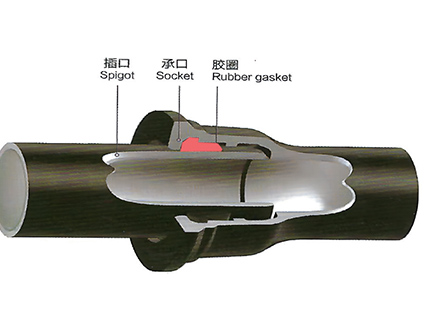 GT-type Joint Ductile Iron Pipe
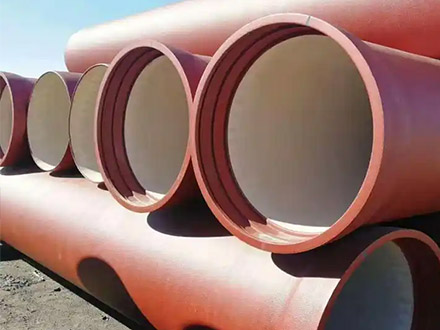
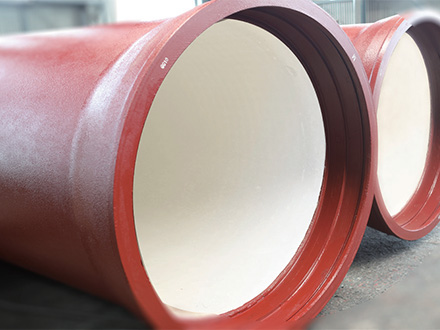 Sewage Pipe (Ductile Iron Sewage Pipe)
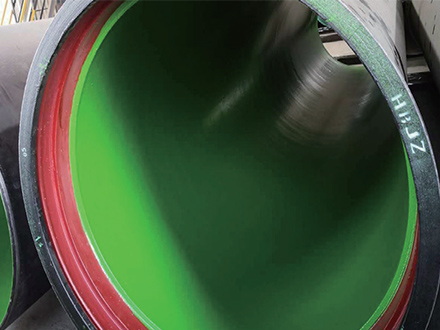 Special Coating Pipe (Ductile Iron Pipe with Special Coatings)