

Ductile Iron Pipe Engineering Solutions for Municipal Water Projects: Complete Guide
Why Engineering Solutions Matter More Than Pipe Supply Only
Core Components of Ductile Iron Pipe Engineering
Pipeline Design and Material Selection
Corrosion Protection Strategy
Installation and Commissioning Support
Integrated Engineering Support for Water Infrastructure
Summary: Key Takeaways
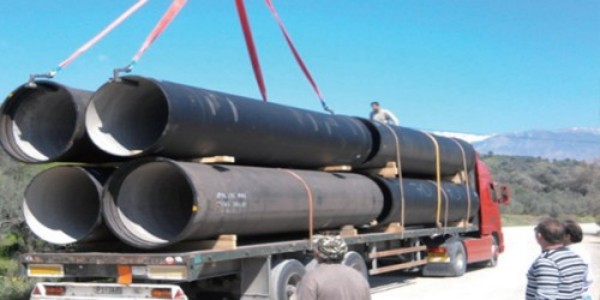
Why Engineering Solutions Matter More Than Pipe Supply Only
Many water infrastructure projects fail not because of pipe quality, but due to inadequate engineering support. Selecting the wrong pressure class, ignoring soil conditions, or improper installation can cause premature failures even with high-quality ductile iron pipe.
Engineering thinking helps with system optimization, risk anticipation, and lifecycle cost reduction. Common failure cases include pipes meeting quality standards but failing early due to improper system design or installation errors.
Proper ductile iron pipe engineering helps buyers reduce project risks, extend pipeline service life beyond 50 years, and minimize maintenance costs. Understanding the complete engineering framework enables informed sourcing decisions that balance cost, quality, and long-term performance.
Core Components of Ductile Iron Pipe Engineering
A complete engineering solution encompasses multiple technical dimensions:
Design Phase
Hydraulic calculations: Flow rate, velocity, pressure loss
Pipe diameter selection: Based on demand projections and pressure requirements
Pressure analysis: Operating pressure, surge pressure (water hammer), safety margins
Route planning: Terrain assessment, obstacle avoidance, access points
Material Selection
Pressure class: K7, K8, K9, K10 based on hydraulic requirements
Coating system: External protection based on soil conditions
Lining type: Internal protection based on water quality
Joint type: Push-on, flanged, mechanical, restrained
Supporting Components
Fittings: Elbows, tees, reducers, flanges
Valves: Gate valves, butterfly valves, air valves, scour valves
Accessories: Thrust blocks, pipe supports, markers
Construction Support
Installation guidance: Proper joint assembly, bedding requirements
Testing procedures: Hydrostatic testing, leak detection
Acceptance criteria: Standards compliance, documentation
Pipeline Design and Material Selection
Proper design and material selection form the foundation of successful water infrastructure projects.
Diameter Calculation
Pipe diameter is determined by:
Design flow rate: Based on population projections and per capita consumption
Allowable velocity: Typically 0.6-3.0 m/s (higher velocities increase pressure loss)
Pressure loss: Friction losses calculated using Hazen-Williams or Darcy-Weisbach equations
Pressure Class Selection
K9 Pressure Class (Standard)
K9 is the industry standard for municipal water transmission and distribution. Following ISO 2531 and EN 545 specifications, K9 ductile iron pipe handles operating pressures up to 40 bar with appropriate safety margins.
Typical applications:
Municipal water supply networks (DN80-DN600)
Raw water transmission from treatment plants
Fire protection systems
Industrial water supply lines
Standards Selection
| Standard | Region | Key Features |
|---|---|---|
| ISO 2531 | International/Middle East/Africa | Most widely adopted |
| EN 545 | Europe | Enhanced requirements |
| AWWA C151 | North America | US-specific requirements |
| SANS 815 | South Africa | Based on ISO 2531 |
Corrosion Protection Strategy
Corrosion protection is critical for achieving 50+ year service life. Selection depends on soil conditions, water quality, and environmental factors.
Soil Assessment
Conduct comprehensive soil testing before selecting external coating:
Soil resistivity: Low resistivity (<2000 Ω·cm) indicates corrosive soil
pH value: pH <6 or >9 requires enhanced protection
Chloride content: High chloride accelerates corrosion
Sulfate content: High sulfate attacks cement lining
External Protection Systems
Standard: Zinc + Bitumen
ISO 2531 requires minimum 130g/m² zinc coating plus bitumen topcoat. Adequate for most soil conditions with resistivity above 2000 Ω·cm and pH between 6-9.
Enhanced: Zinc + Polyethylene Encasement
Aggressive soils require polyethylene encasement over zinc coating. Mandatory for coastal areas, reclaimed land, and industrial zones with contaminated soil.
Special: Epoxy Coating
Fusion-bonded epoxy (FBE) offers superior corrosion resistance for extreme environments such as offshore platforms, chemical plants, and marine installations.
Internal Lining Systems
Standard: Cement Mortar Lining
Cement mortar lining (Class K per ISO 2531) is standard for potable water. Typical thickness 3-6mm depending on pipe diameter. Suitable for water pH 6.5-9.5.
Enhanced: High Alumina Cement Lining
Aggressive water requires high alumina cement lining: low pH water (<6.5), high sulfate water, soft water with aggressive CO₂.
| Condition | External Protection | Internal Lining |
|---|---|---|
| Normal soil, potable water | Zinc + Bitumen | Cement Mortar Class K |
| Aggressive soil | Zinc + PE Encasement | Cement Mortar Class K |
| Coastal/Marine | Epoxy Coating | Cement Mortar Class K |
| Aggressive water | Zinc + Bitumen | High Alumina Cement |
| Both aggressive | Zinc + PE Encasement | High Alumina Cement |
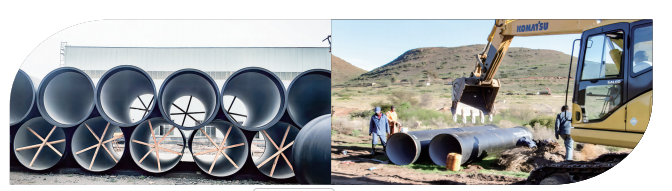
Installation and Commissioning Support
Proper installation is as critical as pipe quality. Poor installation can compromise even the best ductile iron pipe.
Pre-Installation
Pipe inspection: Check for damage during transport, verify coating integrity
Trench acceptance: Verify trench depth, width, and bedding preparation
Bedding preparation: Granular material, proper compaction, level surface
During Installation
Joint assembly: Clean bell and spigot, apply lubricant, push to mark
Deflection limits: Do not exceed 3-5° for push-on joints
Thrust blocking: Install at bends, tees, and dead ends
Backfill requirements: Initial backfill with selected material, proper compaction
Testing and Commissioning
Hydrostatic testing: Strength test at 1.5x operating pressure
Leak testing: Tightness test at operating pressure
Disinfection: Mandatory for potable water pipelines
Flushing: Remove debris before commissioning
| Joint Type | Installation Speed | Labor Requirement | Best Application |
|---|---|---|---|
| Push-on | 300-500m/day/crew | Low | Buried municipal pipelines |
| Flanged | 100-150m/day/crew | High | Pump stations, valve chambers |
| Mechanical | 200-300m/day/crew | Medium | Restrained joint applications |
Integrated Engineering Support for Water Infrastructure
Complex water projects require coordinated engineering support beyond product supply. Tiegu coordinates multiple qualified foundries and technical partners to match project requirements with suitable manufacturing capabilities and engineering expertise.
We review technical specifications, coordinate production timelines, and ensure documentation compliance. This helps buyers reduce project delays and quality disputes in water infrastructure projects.
Our engineering support includes:
Technical specification review and optimization
Supplier matching based on capability and capacity
Production coordination across multiple facilities
Documentation verification before shipment
Installation guidance and troubleshooting
Submit your project specifications for technical evaluation and integrated solution support.
Summary: Key Takeaways
Complete engineering solutions reduce lifecycle costs by 30-40% compared to pipe-only procurement over 50-year service life
K9 pressure class with cement lining meets most municipal water project requirements — specify K10/K12 only when hydraulically justified
Soil assessment determines external coating selection: standard zinc+bitumen for normal conditions, polyethylene encasement for aggressive soils
Installation quality directly impacts pipeline service life — proper joint assembly and bedding are critical
Verify supplier's engineering capability and project references before contract signing, not just product certifications
Request comprehensive documentation package including mill certificates, test reports, and coating inspection
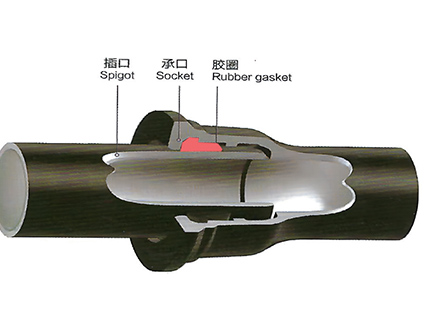 GT-type Joint Ductile Iron Pipe
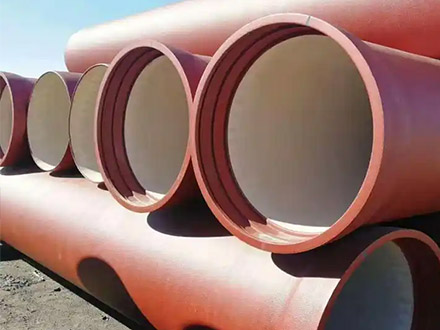
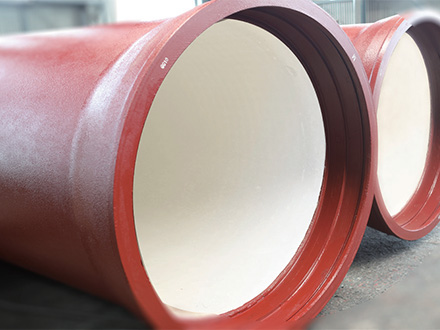 Sewage Pipe (Ductile Iron Sewage Pipe)
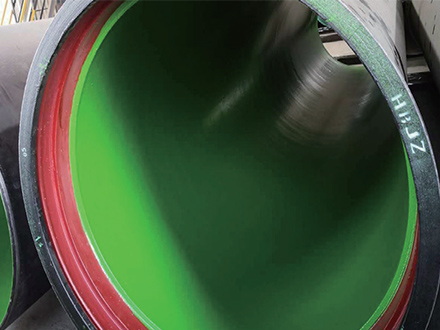 Special Coating Pipe (Ductile Iron Pipe with Special Coatings)