

ISO 2531 and SANS 14394 explained for South African contractors: pressure classes, coating requirements, testing standards, and compliance checklist for ductile iron pipe procurement.
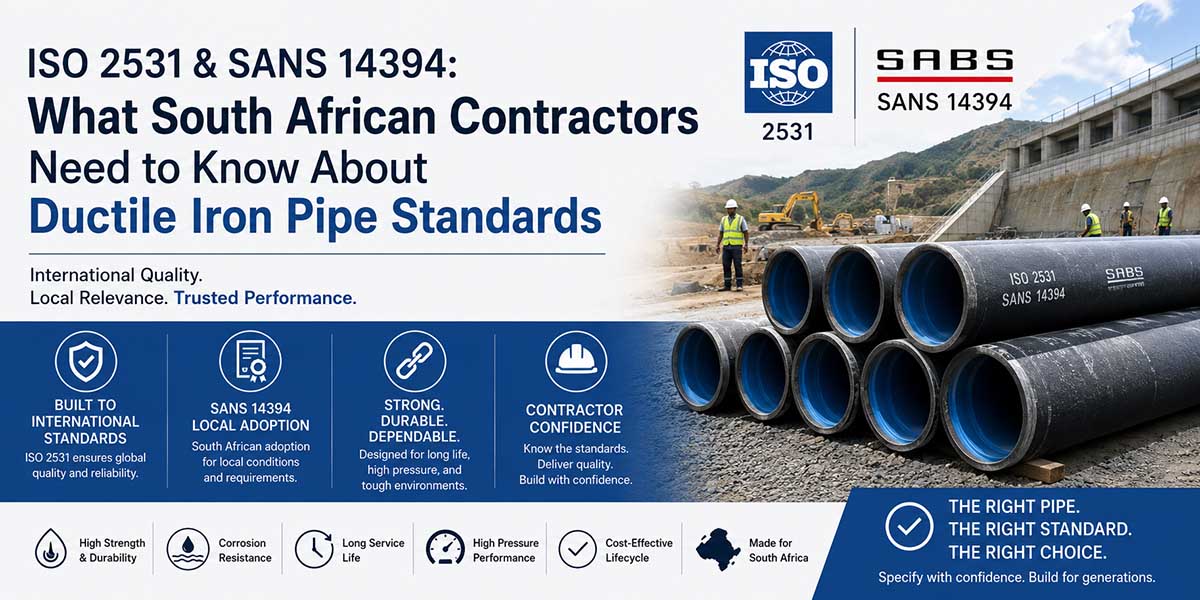
Why Do South African Projects Require Both ISO 2531 and SANS 14394?
South Africa's engineering procurement system operates on a dual-standard framework that can create confusion for international suppliers and local contractors alike.
ISO 2531 is the globally recognized standard for ductile iron pipes, fittings, and accessories for water and other liquid applications. It covers everything from pipe dimensions and pressure ratings to cement mortar lining and external coating specifications. Most ductile iron pipe manufacturers in China produce to ISO 2531, making it the default specification for international procurement.
SANS 14394 is South Africa's national standard, published by the South African Bureau of Standards (SABS). It is substantially equivalent to ISO 2531 but includes additional requirements specific to South African regulatory and certification frameworks. For municipal water projects funded by government budgets, SANS 14394 compliance — backed by SABS certification — is typically mandatory.
For a complete overview of South Africa water pipeline projects including material selection, standards, procurement, and logistics, see our South Africa Water Pipeline Complete Guide 2026 →
What Are the Pressure Classes Under ISO 2531?
Understanding pressure classes is critical for South African contractors because municipal water systems vary dramatically in operating conditions — from low-pressure distribution networks in flat coastal areas to high-pressure transmission mains in inland high-elevation regions.
ISO 2531 defines pressure classes based on Maximum Operating Pressure (MOP) and Pressure Maximum Admissible (PMA):
| Pressure Class | MOP (bar) | PMA (bar) | Typical Application |
|---|---|---|---|
| K7 | 20 | 25 | Low-pressure distribution networks |
| K8 | 30 | 37.5 | Medium-pressure water mains |
| K9 | 40 | 50 | Standard for most municipal projects |
| K10 | 50 | 62.5 | High-pressure transmission mains |
| K12 | 63 | 78.7 | Special high-pressure applications |
K9 (PN40) is the most widely specified pressure class for South African municipal water projects. It covers the majority of operating pressure scenarios — from standard distribution networks (PN10-PN16) to bulk transmission pipelines (PN25-PN40). K9 provides a safety margin for water hammer and surge events without the cost premium of K10 or K12.
For projects in high-elevation areas like the Highveld region, where static head and pumping pressures combine to create elevated operating conditions, K10 (PN50) may be required. Contractors should verify the hydraulic design report to confirm the correct pressure class before procurement.
What Coating and Lining Requirements Must Be Met?
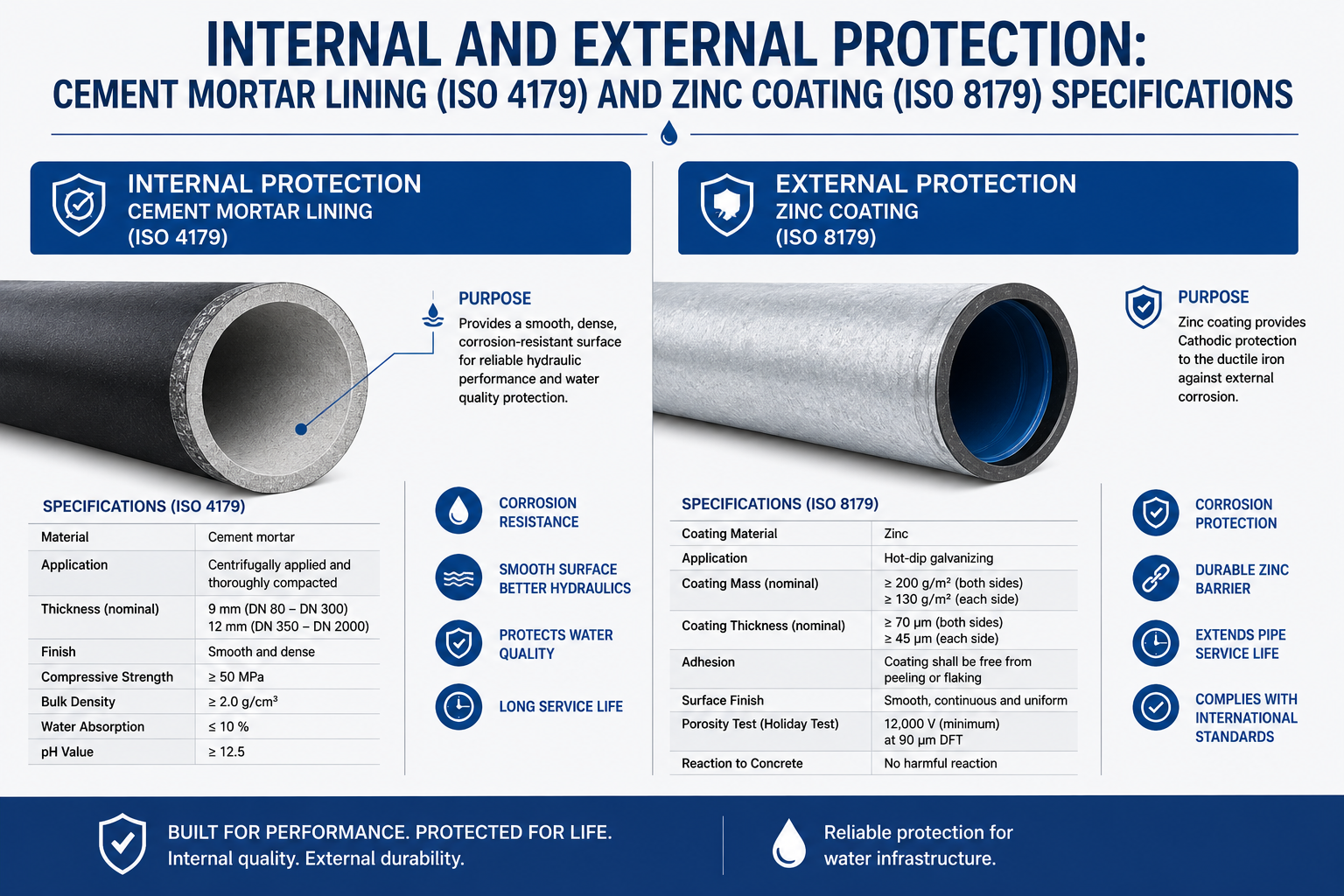
ISO 2531 specifies mandatory internal and external protection systems for ductile iron pipe. These requirements are non-negotiable for water infrastructure projects because they directly affect pipe service life, water quality, and maintenance costs.
Internal Protection: Cement Mortar Lining (ISO 4179)
ISO 2531 requires cement mortar lining for all ductile iron pipes used in water applications. The standard specifies minimum lining thickness based on pipe diameter:
DN80-DN300: Minimum 2.0mm lining thickness
DN350-DN1200: Minimum 2.4mm lining thickness
DN1400-DN2000: Minimum 3.0mm lining thickness
Cement mortar lining serves two critical functions: it prevents internal corrosion (maintaining pipe wall thickness and pressure capacity) and provides a smooth internal surface that preserves flow capacity (Hazen-Williams coefficient C = 140-150). For South African projects treating potable water, cement lining also helps maintain water pH stability and reduces disinfectant demand.
External Protection: Zinc Coating + Bitumen Paint (ISO 8179)
ISO 2531 mandates external zinc coating as the primary corrosion protection system. The standard requires:
Zinc coating: Minimum 130g/m² (per ISO 8179-2)
Bitumen paint overlay: Minimum 70μm dry film thickness
The zinc coating provides cathodic protection — zinc sacrificially corrodes to protect the underlying iron, even if the coating is scratched or damaged during installation. The bitumen paint overlay provides an additional barrier and protects the zinc from rapid consumption in certain soil conditions.
How Does SABS Certification Work for Imported Pipe?
For South African contractors sourcing ductile iron pipe from international suppliers, SABS certification is often the most complex part of the procurement process. Here's what you need to know:
When is SABS certification required?
Government-funded municipal water projects (national and provincial)
Projects managed by water boards (Rand Water, Umgeni Water, Bloemwater)
Tender documents that explicitly specify SANS 14394 with SABS mark
What does SABS certification cover?
Product testing per SANS 14394 requirements (pressure testing, dimensional verification, coating thickness)
Factory quality management system audit (ISO 9001 certification is typically required as a prerequisite)
Third-party inspection by SABS-approved testing laboratories
Ongoing surveillance audits to maintain certification validity
How long does SABS certification take?
The certification process typically requires 8-12 weeks from initial application to certificate issuance. For urgent projects, some contractors arrange third-party testing (by accredited laboratories such as SGS, Bureau Veritas, or TÜV) as an interim measure while SABS certification is processed.
Common Problems in Standard Compliance & How to Avoid Them
Contractor procures ISO 2531-compliant pipe from China, but the supplier cannot provide SABS certification. The pipe is rejected at site inspection, causing project delays and replacement costs.
Solution: Confirm SABS certification requirement in tender documents before procurement. Verify supplier's SABS certificate number with SABS database. Request certificate copy as part of pre-qualification documentation.
Engineer specifies PN16 MOP, but supplier delivers pipe rated for PN16 PMA — which means the actual MOP is only PN10. The pipe fails during hydrostatic testing.
Solution: Always specify MOP (Maximum Operating Pressure), not PMA. Verify that material test reports clearly state MOP rating. For K9 class, MOP = 40 bar, PMA = 50 bar.
Contractor specifies standard zinc + bitumen coating without conducting soil resistivity testing. In aggressive soil, external corrosion causes pipe failures within 8-12 years.
Solution: Conduct soil testing (resistivity, pH, chloride, sulfate) along the pipeline route before specifying external protection. Use ISO 12234 soil corrosivity classification to determine coating requirements.
Quality Assurance for South African Pipe Projects
Tiegu coordinates production with ISO 2531-certified foundries that have experience supplying South African municipal water projects. We verify SABS certification status, review material test reports, and confirm coating specifications before shipment.
This means South African contractors receive pipe with complete documentation — including mill test certificates, cement lining thickness reports, and hydrostatic test records — coordinated through a single supply chain partner.
You can share your tender specifications or pipeline requirements for technical evaluation and SABS compliance verification.
📋 Get Free Technical Quotation
Share your tender specifications — receive competitive pricing within 24 hours

✅ Final Recommendation
For South African municipal water projects: Specify K9 ductile iron pipe per ISO 2531 with SABS certification. Verify SANS 14394 compliance in tender documents and confirm SABS certificate validity before procurement.
Compliance checklist:
✅ Pressure class: K9 (PN40 MOP) for most municipal applications
✅ Internal lining: Cement mortar per ISO 4179 (minimum 2.4mm for DN350+)
✅ External coating: Zinc (≥130g/m²) + bitumen per ISO 8179, or epoxy + PE encasement for aggressive soils
✅ Certification: SABS mark required for government/municipal projects
Frequently Asked Questions
What is the difference between ISO 2531 and SANS 14394?
ISO 2531 is the international standard for ductile iron pipe in water applications, defining technical specifications including dimensions, pressure classes, and coating requirements. SANS 14394 is the South African national standard, substantially equivalent to ISO 2531 but requiring SABS certification for government and municipal projects. A pipe manufactured to ISO 2531 with proper third-party testing can typically satisfy SANS 14394 requirements.
Is SABS certification mandatory for imported ductile iron pipe in South Africa?
SABS certification is mandatory for government-funded municipal water projects and projects managed by water boards (Rand Water, Umgeni Water, Bloemwater). For private sector projects, ISO 2531 compliance with third-party inspection may be acceptable. Always verify certification requirements in the tender documents before procurement to avoid site rejection.
What pressure class is required for South African municipal water projects?
K9 (PN40 MOP, PN50 PMA) is the standard pressure class for most South African municipal water projects, suitable for operating pressures up to 40 bar. K10 (PN50) and K12 (PN63) are specified for high-pressure transmission mains and special applications. K7 (PN20) and K8 (PN30) may be used for low-pressure distribution networks in flat terrain.
How long does SABS certification take for Chinese-manufactured pipe?
The SABS certification process typically requires 8-12 weeks from initial application to certificate issuance, including factory audit, product testing, and documentation review. For urgent projects, some contractors arrange third-party testing by accredited laboratories (SGS, Bureau Veritas, TÜV) as an interim measure. Working with a supplier who already holds valid SABS certification eliminates the certification timeline entirely.
📞 Contact Us for ISO 2531 & SANS 14394 Compliance
Tiegu — Professional Casting Export Partner
📱 WhatsApp / WeChat: +86 152 5613 5588
📧 Email: zbw@tiegu.net
🌐 Website: www.ductileironpipe2600.com
💬 Inquiry Form: Submit Your Requirements
Response Time: We typically respond within 24 hours with technical specifications, pricing, and delivery timelines for your project.
Related reading: South Africa water infrastructure market overview → | Tender specification guide →
Summary: Key Takeaways
ISO 2531 is the international standard for ductile iron pipe; SANS 14394 is the South African adaptation requiring SABS certification for government projects.
K9 (PN40 MOP) is the standard pressure class for most South African municipal water projects, covering PN10-PN40 operating pressure scenarios.
Cement mortar lining (ISO 4179) and zinc coating (ISO 8179) are mandatory per ISO 2531 — minimum 2.4mm lining and 130g/m² zinc for DN350+ pipes.
For aggressive soils (resistivity <3,000 Ω·cm), specify epoxy coating + PE encasement instead of standard zinc + bitumen.
SABS certification requires 8-12 weeks; verify supplier's certification status before procurement to avoid project delays.
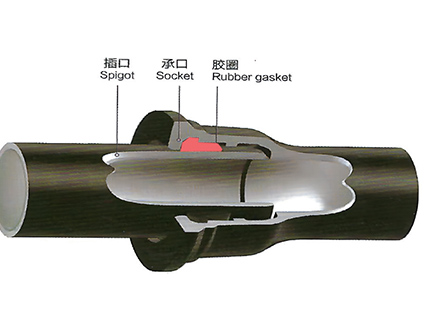 GT-type Joint Ductile Iron Pipe
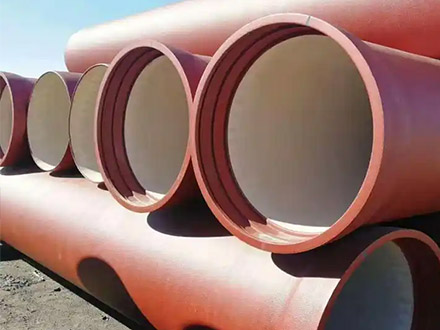
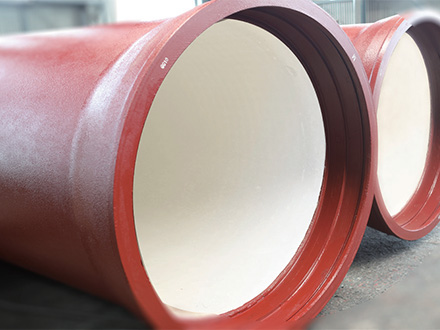 Sewage Pipe (Ductile Iron Sewage Pipe)
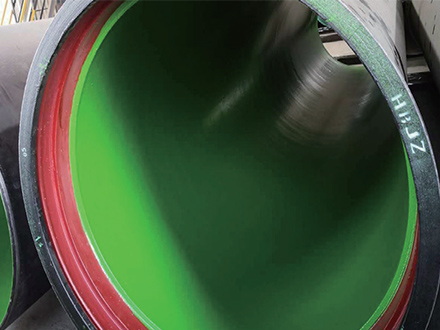 Special Coating Pipe (Ductile Iron Pipe with Special Coatings)